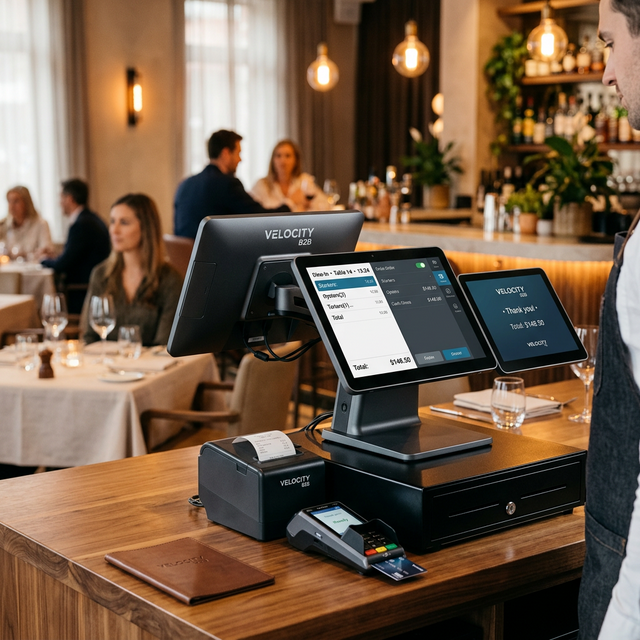
Why Sales Volume Alone Does Not Protect Restaurant Profit
High cover counts do not intrinsically translate into optimized margins. Operational inefficiencies—such as reactionary staffing, obscured overhead costs, and high-commission third-party delivery channels—erode net profitability systematically, regardless of topline revenue.
Modern restaurant POS (point-of-sale) platforms have evolved substantially beyond transaction processing. Scaling toward $29.32 billion in global market capitalization by 2035, advanced POS infrastructure operates as the sophisticated central nervous system of modern hospitality. These systems continuously dictate resource allocation, ingredient-level margin tracking, and demand-driven labor models.
Running operations on legacy systems represents a persistent, systemic risk against razor-thin margin environments where strategic decisions require instantaneous operational data.
What a Modern Restaurant POS Should Do
Contemporary POS systems integrate the entirety of restaurant enterprise functions into a singular, highly observable command structure.
Optimized architectures interlock the front-of-house management, fully digitized kitchen display systems (KDS), automated inventory depletion tracking, and deep, real-time margin analytics. Customer profiles simultaneously link with behavioral data, enabling pinpoint targeted retention programs.
AmbizTech's RestroPal exemplifies this tier of enterprise orchestration, eliminating fragmented 'bolt-on' applications in favor of a cohesive, native operating system designed precisely for complex multi-channel hospitality environments.
Where Restaurants Lose Margin
Suboptimal Resource Deployment
Labor typically consumes 25-35% of total revenue. Managing schedules without predictive demand analytics results in gross inefficiencies. Advanced POS platforms correlate historic demand modeling with labor spend, enabling meticulous, optimal staffing deployment.
Third-Party Platform Dependency
Delegating order volume to external aggregators charging 25-30% commissions profoundly degrades margins. Custom POS arrays implement robust native first-party ordering flows, instantly recapturing lost operational margin.
Stagnant Commodity Pricing
Static menu pricing is fatal amid fluctuating commodity costs. A superior POS tracks real-time ingredient pricing directly against sales, alerting operators automatically to deteriorating plate-level profitability.
Benefits of a Unified POS Platform
Synchronized Operational Flow
When FOH, BOH, and inventory speak natively, friction vanishes. Orders transmit flawlessly, inventory decrements instantly, and management focuses strictly on experience rather than data reconciliation.
Live Financial Telemetry
Replacing end-of-month post-mortems with real-time analytics ensures that deviations in localized operational metrics are immediately corrected prior to impacting aggregate performance.
Precise Asset Management
Intelligent inventory matrices alert management to utilization spikes and proximity to waste thresholds, exerting strict control over food cost percentages continuously.
Omnichannel Consolidation
Merging dine-in, primary direct-to-consumer online fulfillment, and third-party delivery into a singular interface eliminates catastrophic managerial interface switching during severe peak hours.
What to Plan for During Implementation
Mandatory Assimilation Training
Advanced platform architectures are worthless without absolute operational compliance. Substantial capitalization in comprehensive pre-deployment staff training guarantees high implementation fidelity.
Data Base-Lining
Maximum utility and intelligence emerge after establishing normalized data trends. The urgency of deployment ensures historical operational datasets are aggregated as swiftly as possible.
Ecosystem API Bridging
High-tier POS platforms mandate flawless API integration alongside existing payroll and enterprise accounting constructs to prevent fragmented legacy reporting.
What Restaurant POS Technology Looks Like in 2026
Data illustrates total industry migration: 63% cloud-based adoption with mobile operations becoming fundamentally standard. Technology drives absolute competitive advantage through aggressive workflow velocity.
The horizon dictates embedded predictive modeling—inventory arrays that issue proactive resupply algorithms and AI-driven upselling modules mapped precisely against localized demographic data. Operators deploying modern infrastructures today are building the exact data foundation indispensable for next-generation AI integrations.
How to Roll Out a Better POS System
Establish Intelligence Deficits
Identify the critical operational metrics absent from current management dashboards, such as live food cost percentage.
Prioritize End-to-End Interoperability
Ensure an architecture prioritizing native data flows over a disjointed network of independent micro-applications.
Analyze Total Operational Cost
Evaluate capital expense regarding software ownership over long-term compounded third-party processing subscriptions.
Staggered Sandbox Cutover
Execute transitions during historically low-volume periods utilizing mirrored testing to ensure zero service disruption.
Aggressive Target Tracking
Evaluate deployment success rigorously against strict metrics: gross labor cost stabilization and recaptured platform commissions.
Conclusion
Hospitality systems invariably function as either force multipliers for margin maximization, or structural impediments. Enterprises that consistently dominate their markets leverage wholly unified data ecosystems generating pinpoint financial intelligence.
Obsolete payment processing registers provide no strategic leverage. Initiate discussions with AmbizTech to translate hospitality complexity into streamlined operational superiority.